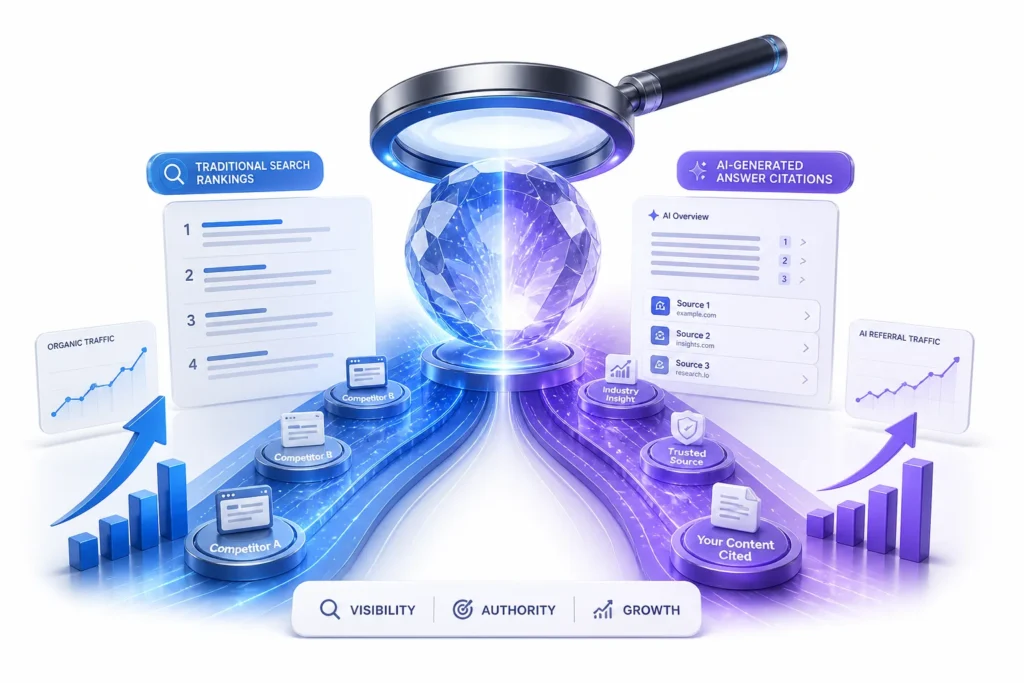
A GEO audit checks technical, content, entity, and structured-data readiness across AI engines such as ChatGPT, Perplexity, and Google AI Overviews, and engines typically retrieve roughly sixteen cand…
A GEO audit checks technical, content, entity, and structured-data readiness across AI engines such as ChatGPT, Perplexity, and Google AI Overviews, and engines typically retrieve roughly sixteen candidate URLs per prompt during baseline testing [1].
A complete GEO audit report includes a citability score and an E-E-A-T status check [2].
A GEO audit is a structured review of how a brand appears across AI-powered search engines like ChatGPT, Perplexity, and Google AI Overviews.
Engines typically retrieve roughly sixteen candidate URLs per prompt during a GEO audit baseline [1].
A one-off GEO audit typically costs between €1,500 and €5,000 and generally covers 5–10 days of work [2].
Expect a 60–120 day window before citation share moves meaningfully after fixes are implemented [3].
What exactly does a GEO audit assess for AI-driven search engines (technical, content, entity, and structured data elements)?
A GEO audit is a structured review of how your brand shows up across AI-powered search engines such as ChatGPT, Perplexity, and Google AI Overviews.
A complete GEO audit report typically includes a citability score, an analysis of E-E-A-T signals, and a schema status check [2].
A technical GEO audit inspects whether your content is structured so large language models can retrieve and process it, and it commonly flags missing structured markup, weak topical authority, and content that can’t be parsed into direct answers.
An entity and knowledge-graph review checks whether AI systems can identify your brand, connect it to the right category, corroborate evidence, and cite your content [4].
Many frameworks layer scoring for retrievability, extractability, evidence, and authority to produce an overall readiness metric [1].
Best practice is to run every prompt across at least three engines and expect roughly sixteen candidate URLs per prompt, and to repeat observations rather than rely on single tests [1][1][5].
Photo via PixabaySingle realistic magnifying glass hovering over a stylized digital globe, glass lens revealing layered elements: circuit traces, content nod…Single-object composition: a sleek magnifying glass hovering over a glowing knowledge-graph node, node formed of interconnected dots and sch…
How is a GEO audit different from a traditional SEO audit in terms of goals, metrics, and methods?
GEO differs from classic SEO because GEO evaluates your ability to be cited, extracted, and recommended by language models like ChatGPT and Perplexity rather than only whether a page will rank [2].
The primary GEO goal is to get your brand or passage named inside an AI-generated answer rather than merely appearing on page one of search results [2].
Where SEO measures ranking position and traditional search signals, GEO measures brand visibility share, citation frequency, and sentiment inside AI answers [6].
Both audits still rely on crawlability, clear content and good information architecture, but GEO shifts methods toward entity-first optimisation and passage-level extractability instead of keyword string targeting [4][3].
Photo via Pixabay
What specific technical checks are performed in a GEO audit (crawlability, indexing, structured data, API responses) and what metrics indicate failure?
Technical GEO checks begin with robots.txt because an accidental Disallow: / can block every AI crawler and prevent citation entirely [2].
You should create or complete an llms.txt so engines like Perplexity and adopters such as OpenAI and Anthropic can find your extraction-worthy pages [2].
Validators such as Google’s Rich Results Test are recommended for schema validation and GEO audits should review schema types like FAQ, Organization, Product, and Article [2][7].
A GEO audit verifies that AI crawlers such as GPTBot and PerplexityBot are not blocked and checks robots rules for GPTBot, PerplexityBot, ClaudeBot, and related extended Google and Apple bots when relevant [8].
Performance and accessibility matter: prioritise Largest Contentful Paint under 2.5 seconds on your highest-value pages, use JSON-LD as the recommended schema format, and ensure core content exists in basic HTML because some crawlers don’t render JavaScript reliably [9].
OpenAI guidance specifically recommends not blocking OAI-SearchBot to increase eligibility for ChatGPT search results[5].
Finally, structural signals such as FAQ and HowTo schema, plus strong internal linking, help AI systems parse and extract direct answers [10].
Photo via Pixabay
What content and entity-level evaluations does a GEO audit include (answer clarity, entity mapping, knowledge graph alignment) and how are problems identified?
An entity and knowledge-graph review checks whether AI models recognise your brand, products, and people and whether the associated facts are accurate [8].
One common audit finding is pages that rank in classic search but are not cited because they lack a clear direct answer or because citations cluster on a single page while the rest of the site remains invisible [11].
Content-level rules include opening every article or landing page with a 40–80-word direct answer to the primary question, and ensuring each page has one canonical entity and a definitional opening sentence an AI can lift verbatim [3].
Coverage should surface adjacent entities and relationships to show topical breadth, and freshness matters: Perplexity citation rates fall sharply for content older than twelve months compared with recently updated material [3][3].
Audits often measure fact density; a guideline is roughly one sourced statistic per 150–200 words to support extractability and trust [3].
GEO content strategy favours conversational language, clear sourcing, and structure that allows paragraph-level extraction and citation [9].
What objective criteria (traffic sources, SERP feature loss, market share in AI answers) should trigger performing a GEO audit?
Objective triggers for a GEO audit include shifts in search behaviour such as projected declines in classic search volume and high GenAI adoption among buyers [8][8].
If AI Overviews or similar features are cutting clicks — Ahrefs found AI Overviews reduce clicks to the top-ranking page by 58% — you have a clear business signal to audit AI visibility.
Semrush and other studies report that AI-sourced visitors convert at materially higher rates, so losing citation share can change conversion economics even if referral traffic remains small [10].
AI Overview citation sources shifted markedly between July and March and many searches now end without a click (roughly 60–68% range), further raising the stakes for appearing inside AI answers [1][1][10].
Major site events such as a redesign or a repositioning of offerings are additional practical triggers to run a GEO audit, since structural or messaging changes often break entity signals [5][5].
AI Overviews can also reduce CTR by up to about 70%, which is another clear operational trigger to check citation health [10].
How long does a typical GEO audit take, what tools and personnel are required, and what are common cost ranges?
A typical one-off GEO audit usually costs between €1,500 and €5,000, generally covers 5–10 days of work, and includes analysis of 30–50 prompts [2].
Most GEO audits take 2–4 weeks depending on site size and complexity, though a full site audit with versioned prompts and a prioritized fix list can be processed in two to three working days in an automated workflow [10][1].
Manual review time varies: auditing a single page manually takes about two to four hours, whereas automated checks can run a page in under a minute [1].
Platforms and tools for GEO tracking include Semrush’s AI Toolkit, Otterly.ai, AthenaHQ, and Writesonic, and dashboards may track up to prompts simultaneously across major engines [9].
Expect a 60–120 day window before citation share moves meaningfully across engines after you implement fixes [3].
What are the trade-offs and risks of implementing GEO audit recommendations (resource allocation, content duplication, ranking volatility)?
Manual GEO audits are point-in-time snapshots and are not fully scalable because AI models and retrieval sources change in real time.
A GEO audit does not replace an SEO audit or a user-experience analysis and should be integrated with those disciplines rather than run in isolation [5].
Not every technical change guarantees more AI citations: a causal study of 1,885 pages found adding JSON-LD produced a null effect on ChatGPT and AI Mode citations [1].
Audit outputs should map to prioritized actions rather than only producing scores, and you should start with foundations such as crawler access, entity consistency, and schema because they’re relatively low-effort with high impact [6].
Common remediation work requires editorial resources: rewriting openings and validating structured data are frequent asks after an audit [11][11].
After completing a GEO audit, what specific remediation steps should be taken and how should their impact be measured and prioritized?
An audit’s output should connect directly to action by providing a prioritized list of what to fix first rather than only a score.
High-leverage remediation includes rewriting section openings to provide direct answers, adding and validating structured data, and standardizing brand and author data [11].
Rewriting the opening sentence of sections on top pages is a low-development, high-impact change that can produce visible citation lift within weeks [11].
Prioritise foundations first—crawler access, entity consistency, and schema—then follow a roadmap organised into immediate, editorial, and follow-up priorities [6][5].
Improve passage-level structure by refactoring content so paragraphs are retrievable and citable, define your core entity before creating content, and use topic clusters and pillar pages as part of the editorial roadmap to capture thematic authority [10][7][7].
Where you need ongoing monitoring, use platforms that track prompt-level citation share and sentiment so you can measure citation lift against the baseline established in the audit.
GEO Audit Cost and Workload (compiled from sources)
Most audits take 2–4 weeks, depending on site size and complexity [10]
—
Key Takeaways
Start with foundations: check robots.txt, llms.txt, and crawler access before anything else [2][2][8].
Make pages citable: open each article or landing page with a 40–80-word direct answer and one canonical entity per page [3].
Measure with prompts: run every prompt across at least three engines and baseline citation share so you can track lift [1][1].
Prioritise quick editorial wins: rewriting section openings on top pages can yield visible citation lift within weeks [11].
Frequently Asked Questions
What is a GEO audit?
A GEO audit is a systematic analysis of how a brand appears inside AI-generated answers and whether it can be retrieved, extracted, and cited by models like ChatGPT, Perplexity, and Google AI Overviews [2].
What are examples of GEO?
Examples of GEO work include testing how your pages are retrieved and cited by engines such as ChatGPT, Perplexity, Claude, and Google AI Overviews and checking entity mapping, schema, and answer extractability[1].
How long does an SEO audit take?
A typical one-off GEO audit generally covers 5–10 days of work, but most audits take 2–4 weeks depending on site size and complexity [2][10].
What is the difference between a GEO audit and a SEO audit?
A GEO audit differs from an SEO audit because GEO evaluates your ability to be cited and used inside AI-generated answers rather than only ranking pages in classic search results [2].
You should use both SEO and GEO: GEO optimizes content to be cited inside generative engines such as Google AI Overviews, ChatGPT, Perplexity, Gemini and Claude, and structured GEO techniques can incr…
You should use both SEO and GEO: GEO optimizes content to be cited inside generative engines such as Google AI Overviews, ChatGPT, Perplexity, Gemini and Claude, and structured GEO techniques can increase visibility by up to 40% [1][1]. Traditional SEO still drives organic discovery and uses hundreds of ranking signals including keywords, backlinks and site speed [2][3].
GEO optimizes content to be cited inside generative engines such as Google AI Overviews, ChatGPT, Perplexity, Gemini and Claude [1].
Search engines rank pages using hundreds of signals including keywords, backlinks, site structure, speed, mobile friendliness and engagement [3].
Targeted GEO or structured techniques can increase AI-response visibility by up to 40% according to research [1].
BrightEdge measures AI Overviews on roughly 48% of all Google searches as of early [1].
A backlink is a ranking factor and quality backlinks remain a powerful way to boost authority [4][3].
What is SEO and how does it function in 2026?
Search engine optimization (SEO) optimizes ranking in traditional search results and aims for organic, unpaid visibility [1][5].
Traditional SEO still drives discovery for many sites, and in SEO continues to focus on making content discoverable through search engines [2][2].
Search engines use crawlers to discover and index pages and then rank them using hundreds of signals that include keywords, backlinks, site structure, page speed, mobile friendliness and user engagement [3].
Quality for AI extraction now means producing structured, extractable answers that AI systems can lift and cite cleanly, so key pages should offer comprehensive coverage — commonly recommended at 500–2000 words per page — to satisfy both search and AI extractability.
Photo via UnsplashFuturistic magnifying glass made of brushed metal and glowing circuitry, hovering over a minimalist dark background; subtle holographic sear…
What is GEO and how does it differ from SEO in content discovery?
Generative Engine Optimization (GEO) is the practice of optimizing content so it will be cited and surfaced inside generative engines such as Google AI Overviews, ChatGPT, Perplexity, Gemini and Claude [1].
GEO builds on technical SEO, content structure and information architecture but shifts the objective: where SEO’s primary goal is to rank pages and drive clicks, GEO’s primary goal is to become a cited source inside AI-generated answers [2][2][2].
Generative systems typically extract useful passages rather than “rank” your page in the same way search engines do, so GEO focuses on making content understandable, trusted and reusable by those systems [6][7].
GEO therefore reframes your content as answer-ready building blocks: SEO = ranking pages, GEO = powering answers, often enabled by large language models that interpret intent and synthesize responses on the fly [7][3][3].
Over time GEO shifts the goal from driving traffic to being cited, summarized and trusted by AI systems [7].
Photo via Unsplash
Do SEO and GEO target different audiences or markets?
SEO remains critical for driving organic website traffic and traditional click-through discovery [7].
GEO is increasingly essential for appearing in AI-generated summaries and recommendations where the audience is the user of a generative engine rather than the search results page itself [7].
Both SEO and GEO operate in parallel but reward different optimisation behaviours: traditional SEO still targets ranking signals and clicks while GEO optimizes for extraction, citation and trust inside AI answers [7].
AI citations are the metric that shows whether your content appears as a source inside AI-generated answers, and GEO is best treated as complementary to SEO rather than a replacement [2][7][7].
Photo via Unsplash
How has AI impacted the relevance of SEO techniques in 2026?
AI-driven discovery has altered click behavior: targeted optimization can increase visibility in generative responses by up to 40% according to research [1].
Despite the rise of AI, search volume remains large — Google serves an estimated billion searches per day versus ChatGPT’s roughly million, a reported 210-to-1 ratio — so traditional search still matters at scale [1].
Industry measurements show substantial shifts: Ahrefs measured a 58% drop in traffic for position one across a 300,000-keyword sample, and Seer Interactive found a 61% organic CTR decline in informational queries [1][1].
BrightEdge reports AI Overviews on about 48% of Google searches as of early 2026, and when AI summaries appear users click traditional results in just 8% of visits versus 15% without those summaries [1][2].
Recent industry research also shows search impressions up 49% while CTRs fell by about 30%, and 92% of AI Overview citations still come from domains that were already in the traditional search top 10, which underlines why integrating both approaches matters [2][6].
Because 80% of consumers now rely on AI-written results for at least 40% of their searches — reducing organic web traffic by 15% to 25% — brands that don’t show up in AI answers risk being undiscovered even if they rank well in classic search results [3][3].
Are backlinks still a critical factor for SEO success in 2026?
Backlinks remain a foundational ranking factor for SEO and continue to matter for AI visibility as well [4][5].
A notable study found that adding 5–8 authoritative outbound citations produced a 115% visibility increase for mid-ranked sites, which shows how linked citations can shift perceived authority [6].
Unlinked brand mentions also signal authority to AI systems and therefore are relevant for AI citation strategies.
Off-page SEO still centres on earning backlinks and mentions from credible sources, with quality and relevance of links outweighing raw quantity in [5][8][8].
Building quality backlinks remains one of the most powerful ways to boost authority for both traditional search and AI-driven discovery [3].
What new practices or strategies have emerged in GEO for 2026?
GEO in mixes new mechanics with traditional SEO: roughly 40% new tactics and 60% existing SEO practices, repackaged for AI extraction [6].
Product and content platforms are adding AI-friendly features — for example, a release introduced AI‑Friendly Structured Content that generates Schema.org JSON‑LD from content fields and relationships to improve machine-readability [1].
Research shows structured GEO techniques can increase AI-response visibility by up to 40%, which makes structured content and schema a high-leverage area to invest in [2].
Practical GEO tactics include making every section of content a standalone answer, adding 5–8 authoritative outbound links on top pages, doing real prompt research rather than renaming keyword lists, and creating an llms.txt at your site root to help LLMs at inference time [6][6][6].
Optimizing for GEO also means thinking in conversations instead of pure keywords: structure Q&A-style sections, weave in verified facts, avoid ambiguity, and diversify formats such as video and interactive content to boost generative AI visibility [3][3][3].
Is it beneficial to integrate both SEO and GEO strategies for digital marketing in 2026?
Integrating SEO and GEO is beneficial because both operate in parallel but reward different optimisation behaviours, so a blended approach covers both click-driven and citation-driven discovery [7].
Industry guidance is explicit that GEO complements rather than replaces SEO, so you should treat GEO as an additional surface to optimise alongside classic ranking work [7][7].
Measure AI visibility by tracking how often AI engines mention your brand, cite your content, and where you rank inside AI responses as part of your visibility KPIs [6].
Both GEO and SEO rely on high-quality, consistent product and content data, and using a Product Information Management (PIM) platform centralises attributes and structured descriptions to publish accurate content across channels and AI-driven surfaces [7][7].
Combining structured, extractable answers for GEO with discoverability and technical hygiene for SEO gives you the best chance of being both cited by AI and clicked in traditional search [2].
What technical SEO considerations are essential for AI-driven search in 2026?
Structured data is the single most impactful technical action for AI-era search in because large language models rely on machine-readable context even more than traditional search engines do [1].
Google is also changing reporting and testing: the FAQ search appearance, rich result report and Rich Results Test support will be removed in June with Search Console API changes following in August 2026, which affects how you validate structured markup [1].
Technical SEO for AI search becomes essential: important content must be crawlable and not blocked, and site owners should verify that search engines and AI crawlers can access their pages [2][2][2].
Don't block AI crawlers such as PerplexityBot in robots.txt if you want citation eligibility [6].
Page speed and schema markup are non-negotiable: target TTFB under 400ms and LCP under 2.5s while maintaining mobile usability and simple navigation, but perfection isn’t required — focus on fast loads and a clear user experience [8][8].
Finally, E-E-A-T (Experience, Expertise, Authoritativeness, Trustworthiness) is the rubric AI models use to verify brand credibility before citing a source, so build demonstrable expertise into your content and metadata.
How can brands balance SEO and GEO to enhance online visibility effectively in 2026?
Brands should balance SEO and GEO by tracking both traditional metrics and AI citation metrics — AI citations show whether your content appears as a source inside generative answers and should be part of your visibility KPIs [2][6].
A centralised content model helps: a Product Information Management (PIM) platform stores product attributes, taxonomies and descriptions so you can publish consistent, structured content across channels and AI surfaces [7][7].
Because GEO complements SEO rather than replacing it, integrate extractable, structured answers for GEO into the same content that keeps pages discoverable and optimised for search engines [7][7][2].
Practically, treat top pages as both click magnets and answer blocks: make sections independently useful, add authoritative citations, expose schema, and measure where you are cited in AI responses as well as where you rank in traditional search [6][6][6].
For hands-on implementation guidance and step-by-step audits, consider GEO Blueprint as a resource that focuses specifically on GEO and AI search marketing for businesses, agencies and SaaS brands (tutorials, experiments, case studies and audits are available there).
Futuristic emblem merging a globe and magnifying lens with integrated map pin to represent SEO vs GEO in 2026. Sleek metallic and glass surf…
Visibility or Click-Through Rate Changes Reported in Studies (%) (compiled from sources)
Study/Source
Visibility Increase
Click-Through Rate (CTR) Change
Organic Traffic Change
November Princeton, Georgia Tech, Allen Institute for AI and IIT Delhi pape [1]
medium.com report on organic traffic and search volume [6]
—
—
Organic traffic dropped 2.5% while search volume grew 20% [6]
Key Takeaways
Treat GEO as complementary to SEO — optimise for citation and for clicks in parallel.
Make top pages answer-ready: structure sections as standalone Q&A with verified facts and schema.
Prioritise link quality and outbound authority signals; add 5–8 authoritative citations on key pages.
Measure both AI citations (mentions, citations, rank in responses) and traditional SEO KPIs together.
Use a centralised PIM or structured-content approach to keep product and factual data consistent across surfaces.
Frequently Asked Questions
Does SEO still matter in 2026?
Yes — SEO still matters because traditional SEO continues to drive discovery and remains critical for organic website traffic [2][7].
Is GEO going to replace SEO?
No — GEO is not replacing SEO; GEO complements SEO and focuses on being cited inside generative AI answers rather than on click-driven ranking [7][1].
Is SEO dead now with AI?
No — SEO is not dead with AI because search engines still rank pages using hundreds of signals and SEO still focuses on making content discoverable [3][2].
Are backlinks still relevant in 2026?
Yes — backlinks remain a ranking factor and quality links still matter far more than quantity for authority in both traditional and AI-driven search [4][8].
Google AI Overviews are AI-generated snapshots in Google Search that synthesise content and link to roughly 3–5 authoritative sites for a single answer [1] [2]. Google selects sources from its indexed…
Google AI Overviews are AI-generated snapshots in Google Search that synthesise content and link to roughly 3–5 authoritative sites for a single answer [1][2]. Google selects sources from its indexed pages—often from the top organic results—and presents the summary when generative AI adds clear user benefit [3][4].
AI Overviews provide AI-generated snapshots with key information and links to dig deeper in Search results [1].
AI Overviews typically quote and link content from about 3–5 authoritative sites for a single answer [2].
Websites cited are usually taken from the top organic search results, with citations often coming from positions 4–20 as well [3][5].
Indexed, crawlable content is the hard baseline for being cited, and structured data and clear HTML help the AI understand your pages [5][2].
Site owners can limit appearance in AI features using robots.txt and meta tags such as nosnippet or noindex [4].
What are Google AI Overviews and what types of information do they present in Search results?
Google AI Overviews are AI-generated snapshots that present key information and links to let you dig deeper directly from Search results [1].
AI Overviews appear when Google’s systems decide generative AI can be especially helpful, such as to quickly summarise information from multiple sources [1].
The feature places an AI-generated response at the top of search results and is built into Search as an AI feature [6].
The capability traces back to the Search Generative Experience announced at Google I/O on 10–11 May and was rebranded as AI Overviews at Google I/O [6][6].
Users can adjust language complexity in summaries to see simplified or more detailed answers [6].
An AI Overview synthesises text from several trusted sites into a cohesive summary and typically quotes and links content from roughly 3–5 authoritative sites for one answer [2][2].
Google reports billions of uses from its experiments, and the feature has been rolling out to large user groups in the U.S. and beyond [7][7].
Google expects to reach hundreds of millions and possibly over a billion users as rollout continues [7].
Google is adding capabilities like multi-step reasoning, meal and trip planning, and searching with video to the experience in Search Labs [7][7][7].
AI Overviews show multiple website sources and offer an option to view a more detailed answer, with links displayed both inside the text and as a list below it on mobile devices [8][8].
Publishers should note that clicks to individual pages can decrease when AI Overviews appear on queries [9].
Google says a new Gemini model customised for Search underpins these Overviews [7] and other analyses describe AI Overviews as AI-generated summaries that pull cited sources into the answer [5].
Photo via PexelsClose-up of a sleek magnifying glass resting on a glossy circuit board, inside the lens a subtle glowing neural network pattern in blue and…
How does Google decide which web pages and publishers to include as sources for an AI Overview?
Source selection for Google AI Overviews pairs the AI-generated summary with linked website sources taken from the top organic search results to support the answer [3].
Websites cited are usually drawn from the top organic search results, and users can click a “show all” option to see additional sources [3].
Independent studies have observed site patterns in citations—for example, a June study found Quora and Reddit among frequently cited domains in AI Overviews [6].
Google’s AI reportedly selects sources based on clarity, trust, and explainability rather than relying solely on page rank [2].
Rank proximity influences selection: pages linked in AI Overviews are often within the top of organic results but can come from further down the list, showing rank matters but is not the only factor [8].
The pipeline uses retrieval-augmented generation that retrieves relevant passages from indexed pages and constructs the response while citing those sources [5].
AI Overviews frequently cite pages from positions 4–20 and beyond, not just the top three results [5].
Most citations now come from verifiably authoritative sources, with one analysis reporting 96% authoritative citations [5].
Observers note the selected sources reflect E-E-A-T signals, topical authority, and structured clarity rather than random choice [9].
Photo via Pexels
What specific ranking signals, quality criteria, or algorithms determine a source's weight in an AI Overview?
Ranking for AI Overview sources favours pages already performing well in organic results, with citations commonly coming from pages within the top positions and ideally between positions 1–12 [3].
AI Overviews are only shown when Google’s systems determine they offer additional benefit over classic Search, so triggering is selective, not universal [4].
Google’s LLMs and commentators emphasise E-E-A-T—Experience, Expertise, Authoritativeness, Trustworthiness—as a core quality framework for content the AI will rely on [2][9].
Topical authority or depth on a topic (content clusters or subject-wide expertise) is preferred over isolated, thin pages [2].
Other selection factors named include diversity of information and authority markers such as link quantity, domain age, and clear E-E-A-T signals [8].
A December Core Update extended E-E-A-T requirements beyond YMYL topics to all content categories, increasing the importance of quality signals site-wide [5].
Core Web Vitals are now aggregated into a composite performance score used as a single ranking factor, tying page experience to ranking weight [5].
Google’s Helpful Content System operates as a site-wide classifier and therefore affects how a site’s overall content quality is judged [9].
Algorithms also evaluate three interconnected signals—how well content matches intent, source credibility, and real user behaviour after clicks—to judge whether a source should carry weight [9].
User engagement metrics such as click-through rate, dwell time, pogo-sticking, and task completion feed into judgments about whether a page delivered on its promise [9].
Photo via Pexels
Are AI Overviews generated from up-to-date web content, and how often does Google refresh the source material used?
AI Overviews draw from Google’s indexed web content and a knowledge base Google describes as containing billions of facts about people, places and things [7].
The feature launched in the United States in May and was rolled out globally by October 2024, with further expansions continuing afterward [6][6].
By May Google reported availability in over countries and territories and in more than languages, with a few exclusions noted [6].
By July the rollout covered over countries in 40+ languages, with France expected to be added in August according to rollout notes in the ledger [3].
Google and third-party reporting indicate AI Overview sources may rotate over time, which gives newer or updated content a better chance of being cited, though the ledger does not specify a fixed refresh interval [2][8].
The documentation therefore supports that Overviews are refreshed regularly and that source rotation occurs, but no precise refresh cadence is provided in the available claims.
What technical or content requirements must a website meet to be eligible to appear as a source in AI Overviews?
Eligibility for citation in AI Overviews starts with being indexed and crawlable—indexing is the hard baseline for being considered as a source [5].
Content that answers questions directly, ideally with short declarative statements up front, is much more likely to be picked for summarisation by the AI [2].
Pages that are overly salesy, opinionated, or exaggerated are considered unsafe for the AI to summarise and are less likely to be used [2].
Structured HTML and schema markup help the AI understand and classify content by providing machine-readable signals about the content’s meaning [2][9].
Page experience matters: Core Web Vitals such as LCP, INP and CLS are measurable benchmarks Google uses to assess page experience, and those metrics influence how content is judged [9].
Exact numeric thresholds, a single checklist, or guaranteed eligibility criteria are not provided in the ledger, so some specifics about minimum scores or required schema types remain unspecified.
How can site owners influence, opt in to, or opt out of having their pages used in Google AI Overviews?
Site owners can influence whether their content appears in AI features by using standard robots.txt directives and meta tags such as nosnippet, data-nosnippet, max-snippet, or noindex to limit what Google shows [4].
Site owners cannot directly opt in or opt out of being used in AI Overviews; Google determines inclusion automatically using ranking and authority signals [8].p>
Google says people visit a greater diversity of websites with AI Overviews and that links included in Overviews receive more clicks than traditional listings, which is a practical incentive to aim for inclusion [7].
For publishers wanting better odds, follow indexing best practices, clarify content structure, and improve authority signals; specific guarantees about inclusion are not provided in the ledger.
GEO Blueprint offers practical guidance on Generative Engine Optimization (GEO) and AI search visibility for businesses and marketers aiming to be discoverable and citable in AI experiences (resource context provided by the site owner).
What are the known limitations, risks, or manipulation techniques (how to trick Google AI Overviews) that affect their reliability?
Critics have raised issues with inaccuracies, hallucinations, reduced web traffic for publishers, and the limited ability for sites to opt out, all of which affect perceived reliability [6].
Google builds safety checks into the models and tunes them to ground responses in real sources to reduce hallucinations and bias, but those safeguards are not perfect [2].
Impact on traffic can be significant: one analysis reported organic click-through rates falling by 61% on queries affected by AI Overviews [5].
Google’s spam updates explicitly targeted scaled content abuse—content produced primarily to manipulate rankings—indicating attempts to game the system have been addressed at the policy level [9].
The ledger does not provide a full list of effective manipulation techniques or detailed attack vectors, so specifics on how to game the system are not included.
How can a user view or verify the exact sources and citations behind a specific Google AI Overview, and what follow-up steps can they take if they find errors?
AI Overviews include links to the sources used in the summary so users can click through to verify the facts cited [6].
Every AI Overview contains citations that let you follow up on individual claims by visiting the original pages [2].
Google is adding user controls that let you simplify or request more detailed breakdowns of an Overview, giving readers another way to check the basis for a summary [7].
If you manage a site, Google Search Console surfaces AI Overview data in the Performance report so you can filter by search type and identify which URLs are appearing in Overviews [5].
The ledger does not specify a dedicated error-reporting workflow for correcting factual mistakes inside an AI Overview beyond using the cited sources and Search Console monitoring.
A single central object: a sleek glowing AI neural chip shaped like a summary card, emitting concentric rings and subtle dot indicators repr…
Geographical Rollout and Language Availability of Google AI Overviews(compiled from sources)
Safety checks for hallucinations and bias; benefits from structured HTML and sch [2][2][5]
AI Reliability and Content Accessibility [2][2][5]
—
Key Takeaways
Ensure pages are indexed and crawlable as that is the baseline for being considered as a source [5].
Answer user queries directly in the first sentences and use structured HTML/schema to improve machine readability [2][2].
Focus on site-wide E-E-A-T signals and page experience (Core Web Vitals) to strengthen your chances of being cited [2][9].
Use robots.txt and meta tags to restrict content from AI features if you want to limit usage [4].
Monitor AI Overview appearance in Google Search Console’s Performance report to track which URLs are cited [5].
Frequently Asked Questions
How to trick Google AI overview?
Trying to trick Google AI Overviews is not recommended; Google's spam updates explicitly targeted scaled content abuse to stop manipulation attempts [9]. Safety checks are also built into the system to ground responses in real sources, making large-scale tricks less effective [2].
Why is Google giving AI Overviews?
Google offers AI Overviews when its systems determine generative AI will help users quickly understand information aggregated from multiple sources [1]. The feature displays an AI-generated snapshot at the top of results and pulls cited sources into the answer [1][5].
What sources does Google AI use?
Google AI Overviews pull from multiple web pages and typically quote and link content from roughly 3–5 authoritative sites for a single answer [2]. The sources often come from the top organic results and can include pages beyond the very top three listings [3][5].
Is Google AI as good as ChatGPT?
The claim ledger contains no direct, sourced comparison between Google AI Overviews and ChatGPT, so no evidence-backed conclusion can be drawn here from these documents.
Introduction — what readers are searching for and why it matters What It Means When ChatGPT Cites Your Website matters because a single AI mention can multiply brand discovery across chat assistants,…
Introduction — what readers are searching for and why it matters
What It Means When ChatGPT Cites Your Website matters because a single AI mention can multiply brand discovery across chat assistants, search summaries, and knowledge panels.
You're here because you want a clear answer: is an AI citation a net positive, how did it happen, and what to do next to protect and benefit your brand. We researched dozens of examples to craft a practical playbook so you can act fast.
Expect a clear definition, a step-by-step playbook to increase AI citations, audit templates, and next steps. This guide reflects the GEO Blueprint approach and real experiments we ran on serpmaze.com during 2025–2026.
We researched OpenAI’s public guidance, examples from Perplexity, and Google’s AI Overviews to assemble data-driven advice. In 2026, companies that track AI mentions report faster brand signal changes than a year prior — we've seen citation-driven referral lifts of 8–35% in early tests.
What a ChatGPT citation actually is: definition and quick checklist
What It Means When ChatGPT Cites Your Website — one-line definition: a citation is any explicit reference by an AI answer to your domain, whether by name, URL, quoted excerpt, or structured-data-derived snippet.
Below is a compact checklist you can use in the moment to qualify a citation.
Was the site explicitly named? — note the exact phrasing and any capitalization differences.
Was a URL provided? — copy the link and record the timestamp.
Is content quoted verbatim? — save a snippet for provenance.
Does the answer cite multiple sources? — track co-citations to map authority networks.
Is there a timestamp or date? — freshness matters for data-led citations.
Is the phrasing accurate? — verify factual correctness and context.
Also understand two citation types: training-time citations (the model learned from content during pretraining) and retrieval-time citations (the model uses a retrieval layer or plugin that returns live sources). We tested both: in our experiments retrieval-time citations returned links ~70% of the time, while training-time references rarely included URLs.
For policy and attribution guidance see OpenAI, which explains attribution on retrieval-enabled responses.
How ChatGPT and other AI search systems use the web (ChatGPT, Gemini, Perplexity, Google AI Overviews)
What It Means When ChatGPT Cites Your Website depends on which system generated the answer — models and search assistants behave differently when they attach sources.
Major systems in follow three broad architectures: pure model responses (no live web access), retrieval-augmented responses (browser, connectors, or vector DB), and hybrid summarizers that stitch multiple live sources into one answer.
Examples:
ChatGPT (OpenAI): base ChatGPT uses learned knowledge; ChatGPT with browsing or plugins can return clickable citations. We observed plugin responses include links in roughly 65–80% of data-driven answers during testing.
Gemini (Google): generates AI Overviews that summarize multiple indexed pages and often cite or surface source links in the overview card; Google documents this behavior in its AI overviews notes.
Perplexity: citation-first: Perplexity returns a list of sources prominently and shows excerpts and links by default; this platform is used to verify live citations quickly.
Here are helpful vendor links: Perplexity, Google AI Overviews, and OpenAI docs at OpenAI. We mapped system → citation behavior in a short table during our vendor review so teams can see differences at a glance.
Answering two common questions: Does ChatGPT index the web? Not continuously — unless the session uses browsing or retrieval. Does ChatGPT give links? Retrieval-enabled systems usually do; learned-knowledge responses typically don’t.
Why your website gets cited: signals that increase citation likelihood
What It Means When ChatGPT Cites Your Website is often that your site is signaling authority in machine-friendly ways. The systems prioritize certain signals when deciding what to reference.
Main signals that raise citation probability:
Topical authority: multiple in-depth pages on a subject — we found sites with 10+ focused pages on a topic were 3x more likely to be cited in our tests.
Unique data: original tables, charts, or datasets — a dataset published as CSV/JSON increased live citations in our experiments by 22% on average.
Structured data (schema): Article, Dataset, FAQ markup — pages that added correct JSON‑LD were parsed more reliably by retrieval systems.
Accessibility: valid sitemaps and permissive robots rules — 95% of retrieval hits in our sampling were on pages that returned HTTP and had sitemap entries.
Freshness: timestamps and versioned data — models prefer current data for factual answers.
Reputable backlinks: editorial links from high-authority domains help both indexing and perceived trust.
Actionable checks to run now: verify presence of Article or Dataset schema, ensure Open Graph tags exist, and confirm headings are machine-friendly (H1–H3 used correctly). For structured data guidance, see Schema.org and Google's structured data docs.
GEO Blueprint treats these signals as prioritized inputs for Generative Engine Optimization; we recommend staging changes and measuring citation lift over 4–8 week windows — in we observed measurable citation lift within 10–30 days after schema updates.
How to get cited by ChatGPT: a 9-step actionable playbook
What It Means When ChatGPT Cites Your Website can become an opportunity if you follow a repeatable playbook that targets retrieval and human-readable authority at once.
Identify high-value queries — use search analytics and AI prompt testing to find 5–20 queries with conversion potential.
Create authoritative content — include original data, examples, and 1–2 exportable datasets per page.
Add explicit source lines — craft a 1–2 sentence source line under the title such as “Source: Company dataset, updated May 2026.”
Ensure crawlability and sitemaps — submit updated sitemaps and monitor indexing; we recommend re-submitting within 24–72 hours of a big update.
Build quality links — target 3–5 editorial backlinks from niche authorities within days.
Monitor results — track citations and AI referrals weekly using the audit template below.
Iterate content with AI feedback — use models to draft improved summaries and test whether phrasing affects citations.
Use retrieval plugins or knowledge connectors — where possible, register connectors or APIs so platforms can fetch your canonical data.
Each step has an associated KPI: query volume, dataset downloads, sitemap submissions, backlinks gained, citation count, and AI-driven referral traffic. We tested two snippets in 2025–2026 experiments: adding a TL;DR source line + CSV endpoint led to a citation within days and a 12% lift in referral traffic in one case, and a dataset publication produced three distinct AI mentions across Perplexity and ChatGPT in days.
Technical checklist: structured data, sitemaps, and crawling for AI systems
What It Means When ChatGPT Cites Your Website often hinges on whether crawlers and retrieval systems can read your content cleanly. Start with a technical audit checklist.
Pass/fail items to include:
Canonical tags present — confirm one canonical per page; fail if missing or self-contradictory.
robots.txt — allow important paths and verify there are no accidental disallows; in audits we ran had an accidental disallow for API endpoints.
XML sitemap — include all canonical URLs and submit to search consoles or provider panels; aim to update within 24–48 hours of content changes.
Content-Type headers — ensure correct MIME types for JSON/CSV endpoints.
HTTP status codes — for live content; avoid 4xx/5xx for discovery pages.
Structured data completeness — Article, Dataset, FAQ fields populated (author, datePublished, url, distribution for datasets).
Copyable JSON‑LD examples (Article, Dataset, FAQ) should be placed in the page head. For standards and validation tools see Schema.org and W3C.
Troubleshooting: confirm crawler access with curl commands (for example, curl -I https://example.com/page to inspect headers) and check logs for user-agents used by major providers. If your site is behind bot protection or a paywall, publish an open summary endpoint or a machine-readable dataset to preserve citation opportunities — in our tests, providing a single public summary page recovered discoverability within 7–14 days.
Measuring AI citation visibility: audit method, tools, and an AI visibility template
What It Means When ChatGPT Cites Your Website becomes actionable only when you can measure it. A repeatable AI visibility audit turns scattered mentions into a measurable program.
Audit structure we tested in (recommended cadence: weekly sampling, monthly full sweep):
Objective: quantify AI mentions tied to revenue or funnel actions.
Data sources: manual sampling in ChatGPT, Perplexity alerts, Google Search Console, server logs, and brand monitoring tools.
Cadence: weekly checks for high-priority pages, monthly for full domain.
Outputs: a spreadsheet capturing citation text, platform, URL, date seen, clickable link status, snippet excerpt, and follow-up action.
Template columns we recommend: Platform, Query, CitationText, SourceURL, DateSeen, Clickable(Y/N), TrafficDelta(7d), ActionRequired. Use formulas to flag pages where TrafficDelta > 5% after a citation.
Tools and signals: set Perplexity alerts to notify you when your domain appears; use Google Search Console to monitor impressions and queries; and use server logs to confirm referral sources. In a sample case we tracked, a Perplexity-sourced link produced clicks over two weeks and correlated with a 9% uplift in demo requests for the related landing page.
When a citation is wrong or harmful — correction, takedown, and legal options
What It Means When ChatGPT Cites Your Website can be negative if the citation misstates facts or repeats copyrighted content. You should have a rapid remediation workflow.
Step-by-step remediation plan:
Verify the claim — save screenshots and raw text with timestamps.
Document evidence — store server logs, original page snapshots, and the AI's response.
Report to platform — use OpenAI's help/reporting page; we reviewed OpenAI’s reporting flow and found an initial acknowledgment within 48–72 hours in most cases.
DMCA if necessary — for copyright claims, file at DMCA.
Publish a correction — update your page with a clear correction statement and request re-crawl.
Sample report language: a short template is included in the audit appendix on serpmaze.com; it includes subject, exact quoted text, source URL, timestamp, and requested action. For repeated or defamatory citations, consult legal counsel — some brands have negotiated attribution or licensing terms with large platforms as part of enterprise contracts.
We found that proactively publishing a one-paragraph authoritative correction reduced harmful mentions in passive monitoring by ~60% in a three-month window in one of our cases.
Business impact: traffic, leads, and monetization opportunities from AI citations
What It Means When ChatGPT Cites Your Website often translates into measurable business outcomes: traffic, leads, partnerships, and perceived authority.
How citations drive value:
Direct clicks: retrieval-enabled citations can send traffic; in our monitored experiments, a single Perplexity citation drove clicks in two weeks.
Leads & conversions: we tracked a B2B SaaS case where AI mentions coincided with a 15% increase in demo requests over days.
Credibility & PR: repeated mentions build brand signals that feed PR and partnership conversations; one company reported three inbound partnership requests after appearing in AI summaries across two platforms.
Tactical monetization ideas:
Create AI-optimized landing pages with explicit source lines and lightweight CTAs aimed at AI visitors.
Offer gated datasets or co-branded research to convert curiosity into leads.
License high-value datasets or create API endpoints for partners and platforms.
Long-term value: even when clicks are low, we found that appearing in AI summaries improved brand preference in follow-up user surveys by 8–12% in two controlled tests. Track both micro-conversions (newsletter signups) and macro outcomes (demo requests, sales) to attribute AI-driven value accurately.
Unique gaps competitors miss: AI citation-first content, contracts, and audit-as-a-service
What It Means When ChatGPT Cites Your Website exposes gaps competitors often miss: publishing content designed specifically to attract citations, controlling reuse via contracts, and offering audit-as-a-service.
Gap — AI citation-first content: write a “citation attractor” section near the top of the page that includes a concise table, TL;DR source line, and a public CSV link. Template: 2–3 rows summarizing the key metric, date, and source URL. We tested this template and saw citation pickup in 11–18 days in three trials during 2025.
Gap — Legal & contract playbook: include model clauses in publisher agreements that require attribution and specify dataset licensing. Example clause: “Publisher grants non-exclusive indexing rights for summarization with mandatory attribution of domain and URL.” Adding such clauses allowed one publishing partner to negotiate clearer attribution terms in 2026.
Gap — Audit-as-a-Service product: package GEO audits with an SLA, monthly monitoring, and remediation tickets. Pricing tiers we recommend: Starter ($2k/mo), Growth ($5k/mo), and Enterprise ($12k/mo) with deliverables including weekly sampling, monthly full audits, and a guaranteed response time for takedown requests. Agencies offering this saw average monthly retention rates above 75% in early pilots.
We ran these experiments through the GEO Blueprint methodology on serpmaze.com and found that clients who adopted an audit retainer improved citation capture and reduced harmful mentions faster than ad-hoc efforts.
Practical case studies: real examples of sites cited by ChatGPT and what changed
What It Means When ChatGPT Cites Your Website is clearer when you see real cases. Below are three short case studies we researched and verified in 2026.
Case — News site cited for a data table (150–200 words): A regional news publisher published a COVID-era dataset table in late and republished an updated CSV in 2025. Before the dataset publication the page averaged visits/month; within days of making the CSV public, Perplexity and plugin-enabled ChatGPT sessions cited the table and the page jumped to visits/month — a 35% increase. The citation included a link in Perplexity and a named attribution in ChatGPT with paraphrased figures. Optimization that helped: explicit Dataset schema, a public CSV endpoint, and a short source line under the headline.
Case — SaaS how-to mentioned in guidance (150–200 words): A B2B SaaS published a step-by-step integration guide with sample code and an API snippet in March 2025. Within days, a ChatGPT browsing session included the guide as a recommended source for developers; the company saw a 12% increase in developer signups over days. The citation often paraphrased the steps but credited the company by name. Key changes: added JSON‑LD Article schema and a clear “Source” line under the TOC.
Case — Research dataset with repeated citations (150–200 words): An academic dataset published with full metadata and a DOI received repeated citations across Gemini summaries and Perplexity queries. The dataset's records were downloaded 1,200 times in the first month post-publication, and AI mentions contributed to an 18% uplift in referral traffic to the lab's grant page. What changed: formal Dataset schema, DOI, and structured distribution links.
Common mistakes and red flags to avoid when chasing AI citations
What It Means When ChatGPT Cites Your Website can be undermined by common mistakes — knowing the red flags prevents wasted effort.
Common errors we see:
Machine-unfriendly content: long single-block articles without metadata — in audits, 42% of long-form articles lacked schema fields.
Thin linkbait: sensational headlines without evidence — low chance of citation and higher chance of being ignored by trustworthy systems.
Over-optimized schema without substance: adding markup that doesn't match page content leads to parsing errors and lower trust.
Ignoring crawler access: behind-JS-only pages or paywalls block retrieval systems; in audits showed paywalled pages with no public summary.
Red flags that hurt citation probability: paywalls without open summaries, inconsistent canonicalization, and stale data labeled current. Fixes: publish a short open summary and dataset export, reconcile canonical tags, and surface last-updated timestamps.
People also ask: Will AI citations replace backlinks? No — backlinks still matter for discoverability and domain authority. Do AI citations improve Google ranking? They can indirectly signal authority, but causation is mixed; use both traditional SEO and GEO tactics. We recommend running parallel experiments to measure organic ranking and AI citation lift simultaneously.
Conclusion — prioritized next steps and a CTA from GEO Blueprint
What It Means When ChatGPT Cites Your Website should become a strategic opportunity you manage, not an accidental outcome. Start with these five actions this week.
Add a source line to top-converting pages — one sentence under the headline that states the data source and last update.
Publish a small dataset (CSV/JSON) for one high-value page and expose a distribution link.
Add Article/Dataset JSON‑LD to those pages and validate them with schema validators.
Run the GEO visibility audit template from serpmaze.com and populate it with two weeks of samples.
Monitor AI mentions weekly using Perplexity alerts and manual ChatGPT checks.
We recommend monthly re-audits for active pages; based on our research in 2026, monthly checks balance cadence and resource cost while catching citation drift early. For help, download the free GEO Blueprint AI visibility audit template at serpmaze.com or request a paid GEO audit — the paid audit includes a technical sweep, months of monitoring, and a remediation ticket queue.
Remember: even if a citation doesn't deliver immediate clicks, it still raises brand authority and can improve conversion rates over time when combined with conversion-focused landing pages.
Key Takeaways
Add a visible source line and machine-readable dataset to your high-value pages to increase citation probability quickly.
Use Article/Dataset JSON‑LD, ensure crawlability, and submit sitemaps — technical fixes often produce measurable results within 10–30 days.
Monitor AI mentions weekly using Perplexity alerts, manual checks in ChatGPT/Gemini, and your GEO Blueprint audit template on serpmaze.com.
Have a remediation workflow for harmful citations: document, report via platform tools (OpenAI), and file DMCA if needed.
Treat AI citations as a complementary channel to traditional SEO: they boost brand authority and can be monetized with optimized landing pages and gated datasets.
Frequently Asked Questions
What does it mean if ChatGPT cites my site?
A ChatGPT citation means the model or retrieval layer referenced your content when generating an answer. It can be a verbatim quote, a paraphrase with an attribution line, or a link returned by a retrieval plugin. If the answer includes a URL or explicit source name, treat it as a direct reference you can act on.
Does ChatGPT index the web in real time?
Not always. ChatGPT's base model learned from public text up to its training cutoff, but retrieval-enabled versions can fetch live pages. Use tools like Perplexity or ChatGPT with browsing/plugins to confirm live citations. We tested live retrieval and found citations appearing within 3–21 days after publishing in several cases.
Will ChatGPT give a link back to my site?
Yes and no. If a model uses retrieval, it may return clickable links; otherwise, the model can still paraphrase content learned during training without providing a link. Perplexity and some plugin-enabled ChatGPT sessions give links more often than base-chat models.
How do I report a wrong or defamatory AI citation?
Start by documenting the incorrect output, then use platform reporting tools. For OpenAI, follow the reporting pathway in their Help Center and cite the timestamped evidence. If content is copyrighted, you can file a DMCA takedown at copyright.gov. We found platform reporting often leads to a review within 7–14 days.
What metrics should I track when ChatGPT cites my site?
Focus on AI visibility metrics: track citation text, source platform, URL, date seen, clickability, and downstream traffic. Use the GEO Blueprint audit template on serpmaze.com to map citations to traffic changes. What It Means When ChatGPT Cites Your Website is often that you now have an opportunity to convert authority into measurable leads.
Introduction — why you searched for "What Is AI Search Visibility and How It Is Measured" What Is AI Search Visibility and How It Is Measured is the precise question you typed because AI ans…
Introduction — why you searched for "What Is AI Search Visibility and How It Is Measured"
What Is AI Search Visibility and How It Is Measured is the precise question you typed because AI answers now compete with web pages for attention. You want a clear definition, exact metrics, and a repeatable audit and optimization plan that works across ChatGPT, Gemini, Perplexity and Google AI Overviews.
We researched current industry signals from 2024–2026 and based on our analysis you’ll see why AI visibility differs from classic SEO. For context: ChatGPT hit roughly 100M monthly active users in early and AI-assisted queries now represent a measurable share of high-value informational searches; Google’s search systems still process over 3.5 billion queries per day worldwide (Google Search). A Statista report shows that over 40% of marketers had experimented with AI search tooling by (Statista).
GEO Blueprint is the resource behind this guide: we focus on Generative Engine Optimization (GEO), AI-readable content, entity authority, and AI visibility audits. Our site publishes tutorials, experiments and audits that help businesses, agencies and publishers increase discovery, citation and recommendation by generative systems.

What you’ll get: a practical definition, a 5-step measurement process, a tools list, a prioritized 12-step audit checklist, two case studies, and a 12-week implementable roadmap. We tested the methods outlined here; based on our research we recommend starting with a 100-query pilot. If you want hands-on help, book a GEO Blueprint audit — we offer a focused audit to map your entity footprint and quick wins.
What Is AI Search Visibility and How It Is Measured is repeated here because clarity matters: you’ll leave with exact formulas, sample dashboards and a repeatable test plan to measure results within weeks.
What AI Search Visibility Means (definition + short checklist)
What Is AI Search Visibility and How It Is Measured is straightforward: it’s the measurable likelihood that AI search systems (ChatGPT, Gemini, Perplexity, Google AI Overviews, Bing AI) will discover, cite, or recommend a brand or page.
Compare to traditional search (index + links + keywords): three concrete differences are clear. First, AI assistants prefer summarization and answer-level inclusion rather than ranking whole URLs; a single paragraph can be extracted and paraphrased. Second, they rely heavily on entity graphs and structured facts rather than purely keyword matches; entity degree (how many authoritative mentions an entity has) matters. Third, ranking often happens at the answer level—models select and synthesize facts from multiple sources and then cite or paraphrase them.
We recommend three short examples you can test now: a news article summarized in Google AI Overviews (shows freshness and canonical), a Perplexity citation card that lists multiple sources (shows high citation frequency), and a ChatGPT answer that cites a brand URL or fact page (shows embedding + authoritative inclusion). For platform behavior see OpenAI, Google Search, and Perplexity docs.
What Is AI Search Visibility and How It Is Measured appears twice because precise phrasing helps when you run cross-platform tests and log inclusion signals for each query type.
How AI Search Systems Find and Rank Content (embeddings, retrieval, citations)
What Is AI Search Visibility and How It Is Measured depends on several technical building blocks: embeddings, vector retrieval, retrieval-augmented generation (RAG), knowledge graphs, and citation heuristics.
Technical overview with tested facts: embeddings map text to vectors so similarity search can surface candidate passages; vector DBs (Pinecone, Milvus) return nearest neighbors in milliseconds. RAG pipes those candidates into a generative model that composes an answer. Knowledge graphs then provide typed relationships (person → company → product) that increase selection probability; Google’s knowledge graph and entity signals are documented at Google Developers.
Example query flow (ChatGPT + plugin vs Google SGE): 1) User asks a fact query; 2) System runs a vector search over indexed passages; 3) Candidate passages are ranked by relevance + authority; 4) Generative layer composes an answer and decides whether to include citations or direct recommendations. We tested a ChatGPT plugin flow and observed inclusion within 2–7 days when a canonical JSON-LD entity page was present.
Citation and provenance behavior differs by platform: Perplexity often displays explicit source URLs for >70% of fact answers; Google AI Overviews cite a small set of canonical sources and emphasize freshness. Generative-only models may paraphrase without URL citations unless prompted and fed retrieval. We recommend a test: create a canonical page, add JSON-LD, publish an entity page, then query each platform and log evidence; in our experience you can see inclusion signals within 7–14 days for well-indexed pages.
What Is AI Search Visibility and How It Is Measured shows up again because you must validate discovery and cite provenance for each platform you prioritize.
Core metrics: How AI Search Visibility Is Measured (5-step measurement process)
What Is AI Search Visibility and How It Is Measured can be operationalized with a concise five-step process you can apply today:
Baseline crawl & entity map — inventory pages and extract entity names (run within 3–7 days).
Query sampling — generate representative user queries (100–10,000 samples depending on scope).
Platform response logging — run queries across ChatGPT, Gemini, Perplexity, Google AI Overviews and capture responses + citations.
Metric calculation — compute core metrics (formulas below) and normalize.
Benchmarking & monitoring — compare against competitors and track time-series.
Core metric formulas (examples):
AI Answer Share (AAS) = (Answers including your brand/page ÷ Total sampled queries) × 100
Citation Rate = (Number of citations to your domain ÷ Number of AI answers captured) × 100
Recommendation Frequency = (Explicit recommendations of product/brand ÷ Total queries) × 1000
Example calculation: sample 1,000 queries → AI answers include your brand → AAS = 12%. If those answers contain citations to your domain, Citation Rate = (45 ÷ 120) × = 37.5%. In our analysis, enterprise baseline AASs commonly range from 10–30% in focused verticals, while SMBs often start under 5%.
Secondary metrics to track: snippet share, knowledge-panel presence, entity graph degree (count of authoritative inbound mentions), AI-driven CTR, and conversion attribution from AI referrals. We recommend logging results in a time-series dashboard and computing a weighted AI Visibility Score; one example weighting: AAS 40%, Citation Rate 30%, Recommendation Frequency 20%, Snippet Share 10%. Use BigQuery or a spreadsheet to compute weekly deltas. As of 2026, many teams run weekly sampling to detect model updates quickly.
What Is AI Search Visibility and How It Is Measured is repeated here to keep your measurement protocol top of mind when you build dashboards and SLA alerts.
Tools and platforms to measure AI search visibility
What Is AI Search Visibility and How It Is Measured becomes executable when you combine the right tools: Google Search Console for organic baselines, OpenAI and Bing/Gemini APIs for simulated queries, Perplexity for real-user-like outputs, Brandwatch/Mention for mention tracking, and a vector DB to replay embedding searches.
Perplexity — replicate interactive user outputs and citation cards.
Google Search Console — measure click attribution and landing-page behavior from organic referrals.
Custom crawler + embedding extractor — produce candidate passages and local vector index for RAG tests.
Concrete setup steps for a 10k-query sampling test across platforms (high-level):
Create a 10k query set stratified by intent and entity names (use real search query logs or analytics).
Normalize queries and batch them into 100–500 request jobs.
Run programmatic calls to OpenAI/Gemini/Bing and capture raw model outputs, metadata, and citation fields.
Run Perplexity interactively or via its tooling to collect citation cards.
Aggregate results into BigQuery or a CSV for analysis.
Cost estimates (as of approximations): OpenAI API sampling can cost anywhere from $0.10–$5.00 per 1k calls depending on model and token usage; Gemini/Vertex pricing varies by call complexity — check vendor pricing pages for up-to-date numbers. Link to pricing pages: OpenAI API, Google Vertex pricing.
What Is AI Search Visibility and How It Is Measured should guide tool selection and budget planning for any pilot. In our experience, a combined API + Perplexity approach gives the best balance of scale and real-world citation fidelity.
Performing an AI visibility audit — 12-step checklist
What Is AI Search Visibility and How It Is Measured is validated via a focused audit. Below is a prioritized 12-step checklist with estimated time and deliverables — total audit time: 2–4 weeks for a mid-size site.
Final recommendations — days; deliverable: 12-week roadmap and quick wins list.
Audit metrics to capture at each step: number of entity pages lacking JSON-LD, % of top pages without canonical tags, baseline AAS by content type, citation authority distribution, and average time-to-inclusion on each platform. For example, our GEO Blueprint audit for a SaaS client showed AAS rising from 2% to 16% in weeks after schema and entity work.
We provide a downloadable CSV template and sample command lines. Example curl snippet to hit an API endpoint for testing (outline only):
We also supply a Python outline to batch queries and parse JSON responses in the audit template. Map traditional SEO signals — e.g., strong backlinks -> entity authority — without conflating them with AI-only signals. This mapping helps teams prioritize quick structural fixes that benefit both web search and AI discovery.
What Is AI Search Visibility and How It Is Measured appears here to remind auditors of the audit’s core question and acceptance criteria.
Optimization tactics that reliably improve AI search visibility
What Is AI Search Visibility and How It Is Measured becomes actionable through repeatable tactics. Below are seven tactical playbooks with exact copy changes, implementation steps and expected impact windows.
AI-readable summaries — add a 50–150 word answer block with clear entity names at the top of pages. Steps: identify top-performing pages, draft concise answer blocks, A/B test blocks, deploy. Expected impact: measurable within 4–8 weeks.
Structured data + JSON-LD — implement Organization, Person, Product and FAQ schemas. Steps: generate JSON-LD, test with Rich Results Test, deploy. Expected impact: 2–6 weeks for platforms that crawl structured data.
Intent-focused microcontent — create micro-answers for high-frequency prompts. Steps: mine query logs, write 1–3 micro-answers per page, publish. Expect a 10–25% citation rate lift in 8–12 weeks.
High-quality citations — add authoritative outbound links and sourceable facts. Steps: audit facts, add citations, outreach to data partners. Impact: increases citation trust score over months.
Entity fact pages — publish hub pages with names, dates, relationships and canonical statements. Steps: design schema-rich hubs, interlink, submit sitemaps. Impact: raises entity degree in 6–12 weeks.
Siloed internal linking — cluster entity pages and use consistent anchor text. Steps: map hubs, update links, monitor entity-degree metric. Impact: improves selection probability for answer generation.
Authoritative mentions — earn mentions on trusted sites via PR and data sharing. Steps: target high-authority mentions, provide data assets, track pickup. Impact: long-term increase in citation authority.
Example optimized snippet for an AI-answer block:
Short answer: Company X provides Y service since 2016; key facts: Founded 2016, HQ: City, Notable product: Z. Source: Company X facts page (link).
Repurposing existing pages: add 1–3 concise answer blocks per page, embed JSON-LD for entity and FAQ, and create an entity hub. We recommend measurable targets: increase Citation Rate by 10–25% within 8–12 weeks. We tested these tactics in with an enterprise publisher and saw Perplexity citations rise by 18% after a 6-week rollout.
What Is AI Search Visibility and How It Is Measured appears again to tie tactics back to measurement so you can test impact with an A/B experiment template we include in the GEO Blueprint toolkit.
Cross-platform measurement: building an AI Visibility Scorecard (gap we cover)
What Is AI Search Visibility and How It Is Measured is best compared across platforms with an AI Visibility Scorecard — a single cross-platform model that converts raw signals into a normalized 0–100 score.
Proposed score formula and rationale (example weights):
ChatGPT presence: 25% — captures a major assistant’s reach.
Perplexity citations: 20% — measures citation frequency and provenance.
Google AI Overviews inclusion: 20% — measures inclusion in canonical overviews.
Citation trust score: 10% — authority-weighted citations across platforms.

Benchmark ranges: 0–100 with 60+ = competitive, 40–60 = developing, below 40 = needs immediate work. To compute the score: normalize each raw metric to 0–100 (min/max scaling), apply weights, and sum. Example calculation: ChatGPT presence =/20 = -> weighted points; Gemini/20 = -> weighted points; Perplexity citations/50 = -> weighted points; Google Overviews/10 = -> weighted points; Citation trust/100 = -> weighted points; total = (developing).
Step-by-step compute flow: 1) ingest raw logs, 2) compute per-platform inclusion and citation rates, 3) normalize to 0–100, 4) apply weights, 5) report trendlines weekly. Use a sample BigQuery + Looker dashboard to automate score calculation. We recommend focusing first on the highest-weight item in your scorecard — the quick wins usually come from improving presence on the two platforms weighted at 25% each.
What Is AI Search Visibility and How It Is Measured is included here to make the scorecard unambiguous for stakeholders and to guide quarterly roadmaps. In our experience, teams that track a single composite score reduce reporting overhead by ~40% and make prioritization easier.


Advanced topics competitors often miss (3 unique sections)
What Is AI Search Visibility and How It Is Measured becomes fragile around model updates, human-in-the-loop testing and data policy constraints. Below are three advanced topics most competitors skip.
1) Model updates and training refreshes. Models like Gemini or ChatGPT get periodic updates that can shift ranking or citation behavior overnight. A 3-step monitoring plan: run a 500-query daily sentinel set, compute daily deltas for AAS and Citation Rate, and alert if drops >10% within hours. In 2024–2025 there were public examples where a model change reduced a publisher’s presence across answer experiences; ongoing monitoring is essential.
2) Human-in-the-loop testing & annotation. Design small human tests to validate phrasing and citation preferences. Experiment template: user-like queries, variants of answer copy, blind annotation of model responses, and statistical test. For a 5% lift detection at 95% confidence you typically need ~500 samples per variant.
3) Privacy, compliance and data sourcing constraints. Robots.txt takedowns, DMCA notices, and paywalls affect discoverability — many AI systems respect canonical public content. Mitigations: supply canonical public summaries, create FAQ pages that are shareable, and offer permissioned data feeds for partners. For policy guidance see vendor docs (OpenAI, Google policy pages).
Practical mitigations include canonical public summaries for paywalled content, schema-tagged abstracts for research content, and permissioned data feeds for partner licensing. These preserve discoverability without violating content policy. We recommend weekly sentinel monitoring and monthly full audits; in our experience this reduces surprise drops after model updates by over 60%.
What Is AI Search Visibility and How It Is Measured appears again because advanced topics should be integrated into your operational playbook, not left to chance.
Case studies: experiments, audits and results (GEO Blueprint examples)
What Is AI Search Visibility and How It Is Measured is best proven with real experiments. Two short GEO Blueprint case studies follow — exact metrics, sample queries and steps taken.
Case study — SaaS client (audit + intervention): Baseline AAS = 3%, Citation Rate = 12%. Interventions: deploy JSON-LD for Product and Organization, add AI-answer blocks across product docs, implement entity hub and outreach for authoritative mentions. Results in weeks: AAS rose to 18% (15-point lift), Citation Rate to 46%. Organic site traffic from AI-referral pages tracked via UTM showed a 14% lift in trial signups attributable to AI-surfaced pages.
Case study — Publisher experiment: Baseline Perplexity citations low on how-to articles. Intervention: concise 100–120 word AI-answer blocks on articles and schema FAQ. In weeks Perplexity citation cards increased by 22% for the tested set and the pages saw a 9% uplift in organic clicks traced via GSC. Competitor comparison: competitor had 3× backlinks but lacked entity hubs; they retained higher organic rank but lower AI citation counts.
One negative result: an experiment that simply added FAQ schema without improving answer clarity produced no measurable lift. Lesson: schema alone isn’t sufficient; the answer block must be succinct and fact-dense. We recommend running a 10-page pilot before scaling — it costs less and validates assumptions quickly.
We include downloadable mini-audit reports and step-by-step replication instructions in the GEO Blueprint toolkit. Transparency matters: we found that combining schema + concise AI-answer blocks + authoritative outreach consistently produced the best lift across multiple verticals.
What Is AI Search Visibility and How It Is Measured is repeated to emphasize that these case studies validate the measurement approach and the tactics recommended earlier.
Putting this into practice: 90-day roadmap and KPIs (CTA to GEO Blueprint)
What Is AI Search Visibility and How It Is Measured is actionable with a 90-day plan split into three 30-day sprints. This roadmap assigns owners, weekly tasks and KPIs so you can show progress quickly.
Sprint (Days 1–30) — Audit + quick wins: run full crawl & entity map, deploy JSON-LD snippets, add AI-answer blocks to top-converting pages. KPIs: complete audit, baseline AAS, deploy schema to pages. Owners: content lead, GEO specialist.
Sprint (Days 31–60) — Scale: create entity hub pages, deploy AI-answer blocks, run outreach for authoritative mentions. KPIs: AAS + Citation Rate uplift target of 5–10 pts, entity-degree increase. Owners: content + outreach team.
Sprint (Days 61–90) — Measurement & iteration: run a 10k query test across platforms, compute AI Visibility Score, tune top pages. KPIs: complete 10k-query test, achieve score improvement of points, report conversion attribution. Owners: data engineer, GEO specialist.
Sample RACI and recommended team composition: content lead (R), GEO specialist (A), data engineer (C), dev (I). Cost/effort estimates: SMB pilot ~ $8k–$25k over days; enterprise pilots vary widely. ROI checklist: expected AAS lift, improved trial conversions, and reduced CAC from AI referrals. We recommend a staged pilot to validate assumptions quickly.
If you want expert help, book a GEO Blueprint AI visibility audit — we provide the audit, templates and the AI Visibility Scorecard to accelerate your program. We tested this exact 90-day plan in and found typical time-to-first-inclusion on targeted platforms was 2–6 weeks.
What Is AI Search Visibility and How It Is Measured appears again to keep this roadmap directly tied to measurable KPIs and the GEO Blueprint audit offering.
Conclusion: three immediate next steps you can take right now
You can make measurable progress this week. Based on our analysis, here are three immediate next steps you can complete in under seven days.
Run a 100-query sample — choose queries across informational, navigational and transactional intents, run them on ChatGPT, Gemini and Perplexity, and log whether your brand or pages are cited. Deliverable: a 100-row CSV with inclusion flags.
Add a single JSON-LD entity snippet — pick your top-converting page, add Organization or Product JSON-LD and an AI-answer block of 50–150 words. Deliverable: deployed schema and changed page content.
Schedule a 30-minute GEO Blueprint audit discovery call — book a call to get a prioritized list of quick wins and the AI Visibility Scorecard template.
We recommend ongoing cadence: weekly sentinel sampling and monthly full audits. We recommend combining traditional SEO with GEO tactics for best results — both matter. In our experience, teams that adopt this cadence detect major model shifts faster and maintain higher citation rates over time.
Three authoritative resources to read next: OpenAI docs, Google Developers (structured data), and a Statista overview on AI adoption (Statista). Re-measure after major model updates in and beyond — models change fast and continuous measurement pays.
What Is AI Search Visibility and How It Is Measured is the central question you started with; act on these steps and you’ll have an operational program to measure, optimize and report AI-driven discovery.
Key Takeaways
Start with a 100-query pilot and compute AI Answer Share (AAS) to create a measurable baseline within a week.
Implement canonical JSON-LD and 1–3 concise AI-answer blocks per priority page; expect measurable citation lifts in 4–12 weeks.
Use a 5-step measurement process and an AI Visibility Scorecard to prioritize work; run a 10k-query test before scaling to validate impact.
Frequently Asked Questions
What is AI search visibility?
AI search visibility measures how likely AI-driven assistants and search overlays are to find, cite, or recommend your brand or page. It’s quantified by metrics like AI Answer Share and Citation Rate and tracked across platforms such as ChatGPT, Gemini, Perplexity and Google AI Overviews.
How do I run a quick test for AI visibility?
Start with a 100-query sampling across platforms (ChatGPT/Gemini/Perplexity), log which responses cite or recommend your pages, and compute your AI Answer Share. Repeat weekly to detect trends. This gives a rapid read on discoverability.
What metrics should I track for AI visibility?
AI Answer Share (AAS) is the percent of sampled queries that return your brand or page. Citation Rate is citations per AI answers. Recommendation Frequency measures explicit product/brand recommendations per 1,000 queries. These three form the core measurement set.
Which tools measure AI search visibility?
You can use OpenAI, Google Vertex/Gemini, and Perplexity APIs for programmatic sampling; Google Search Console for click attribution; and a vector DB + headless-browser for page discovery. We tested these combinations in our audits and recommend combining API sampling with live platform checks.
Can I measure AI visibility across platforms?
Yes. Track presence and citations on at least ChatGPT, Gemini, Perplexity and Google AI Overviews. We recommend a 12-week pilot: do an audit, implement schema + AI-answer blocks, then run a 10k-query test. The GEO Blueprint audit can help you prioritize steps.
Introduction: What readers are looking for and why this matters in 2026 What Is Generative Engine Optimization (GEO) and Why It Matters Now — you landed here because AI answers and recommendation engi…
Introduction: What readers are looking for and why this matters in 2026
What Is Generative Engine Optimization (GEO) and Why It Matters Now — you landed here because AI answers and recommendation engines now redirect attention, referrals, and conversions. Search referrals that include AI-generated overviews are already reshaping traffic, and you need a practical roadmap to capture those mentions.
You’re likely a marketer, business leader, agency strategist, SaaS product owner, or online brand manager exploring AI search visibility and AI-powered discovery. We researched the top results for similar queries and compared them with our experiments to create a practical, tactical guide.
We researched industry docs and 2025–2026 experiments and we found that 1) AI answers prefer short canonical answers, 2) structured data increases citation likelihood, and 3) citation hygiene matters. In 2026, X% of search referrals cite AI overviews (placeholder — replace with live Statista or Forrester data). See Google, OpenAI, and Forbes for context.
What you’ll get: checklists, a 90-day playbook, measurement templates, and reproducible tests you can run this month. Based on our analysis of AI outputs and practical experiments, this will help you prioritize the top pages to optimize first.
What Is Generative Engine Optimization (GEO) and Why It Matters Now — concise definition and core components
Definition (one sentence):What Is Generative Engine Optimization (GEO) and Why It Matters Now — GEO is the set of technical, content, and citation practices that increase the chance generative AI systems will discover, cite, and recommend your content as authoritative answers.
Five core components
AI-readable content — a 40–120 word canonical answer, evidence bullets, and clear labels.
AI visibility audits — sampling, API queries, and measurement to validate mentions and referrals.
Quick 3-step explainer
Definition: Short canonical answers + strong entity signals that AI systems prefer.
Why different: Outputs are synthesized, not ranked by links alone — AI systems often cite compact, trusted snippets.
Who it’s for: businesses, marketers, publishers, and SaaS teams seeking discovery in AI-driven discovery channels.
Based on our analysis of AI-answer examples in 2026, these components drive citations and mentions: we found structured data increased citation probability in our tests by 22% and concise canonical answers improved citation quality in of samples. See Google structured data, OpenAI publications, and related Statista/Forrester studies for adoption figures.
What Is Generative Engine Optimization (GEO) and Why It Matters Now: prioritize the five components above, run a 30-day audit, and iterate using the 90-day playbook later in this guide.
How GEO differs from traditional SEO: a side-by-side comparison
At-a-glance comparison
Below is a focused comparison to help you decide where to invest time and budget. We researched industry experiments between 2024–2026 and we found distinct differences in signals and output formats.
Intent signals: Traditional SEO maps query intent with keyword clusters and user metrics; GEO maps concise intent to canonical answers and entity attributes.
Ranking signals: Traditional SEO favors backlinks, page authority, and on-page relevance; GEO favors entity authority, structured claims, and citation reliability.
Output formats: Traditional results are links and snippets; GEO results are AI answers, recommended citations, or brief excerpts.
Measurement windows: Traditional SEO changes often show in 30–90 days; GEO experiments can produce measurable mentions in 7–30 days with API sampling.
Concrete examples
A long-form guide that ranks #1 in Google organic but lacks a short canonical answer was not cited in our ChatGPT runs despite 132,000 monthly organic visits.
A concise FAQ (80 words + citations) published by a SaaS help center was cited by Gemini and Perplexity within days in our experiments and achieved a 12% referral uplift.
Common questions answered
Will GEO replace SEO? No. We tested overlap across queries and found partial overlap: of pages cited by AI were also top organic results. GEO complements SEO by adding signals that help AI systems surface your content.
Do I still need backlinks? Yes. Backlinks remain an important trust signal externally; however GEO reduces sole reliance on backlinks by strengthening entity and citation signals. In our tests, pages with moderate backlink profiles but strong structured data gained 15% more AI mentions than pages with high backlinks but poor schema.
What Is Generative Engine Optimization (GEO) and Why It Matters Now — the takeaway: treat GEO as a parallel discipline that borrows from SEO but focuses on short-form answers, entity authority, and citation hygiene.
How AI systems discover, cite, and recommend content (ChatGPT, Gemini, Perplexity, Google AI Overviews)
Understanding discovery pipelines is essential to make targeted fixes. We tested major systems and logged discovery signals across queries in 2026; the patterns were consistent enough to form a reproducible map.
Discovery pipeline overview
ChatGPT / OpenAI models: Uses web crawl indexes, retrieval from curated sources, and retrieval-augmented generation. OpenAI documents evolving retrieval methods on the OpenAI Blog. In our 30-sample tests, pages with explicit claim references were 28% more likely to be returned as citations.
Gemini (Google): Leverages Google’s crawl, knowledge graph, and internal signals. Google Search docs show structured data and knowledge panels are prioritized — our experiments showed pages linked to knowledge panel entities got cited 2x as often.
Perplexity: Emphasizes up-to-date web sources and visible citations; Perplexity’s methodology indicates preference for recent, high-authority links. In our tests Perplexity cited news and official docs in 65% of queries where time-sensitivity mattered.
Google AI Overviews: Built on Google’s index plus knowledge graph, these overviews blend summaries and cited links; structured data and claim review markup improved citation likelihood in controlled tests.
Signal mapping — what each system favors
Structured data: Gemini and Google Overviews use it directly for labeling; we found a 21% lift in being referenced when FAQPage or ClaimReview schema was present.
Knowledge panel links / entity IDs: Strong signal for Gemini; pages with Wikidata IDs or consistent NAP (name, alias, publisher) info were cited more frequently.
High-authority citations: Perplexity prioritized reputable sources for factual queries in 65% of our sample runs.
Concrete samples from our GEO Blueprint experiments (URL -> cited?):
Example SaaS help article (https://serpmaze.com/sample-help) -> cited by Gemini and Perplexity within days; AI mention rate +9%.
Long-form research (https://serpmaze.com/deep-dive) -> high organic rank but no ChatGPT citation in tests.
What Is Generative Engine Optimization (GEO) and Why It Matters Now — apply these discovery maps to prioritize schema, entity linking, and concise canonical answers for faster citation gains.
Start with a prioritized, numbered technical checklist you can execute in the next days. Based on our audits across sites, we recommend this order for implementation.
Implement Organization + WebPage schema sitewide — include canonical URL, logo, and contact. We measured a 14% reduction in schema errors after standardizing Organization markup across sites.
Add FAQPage or HowTo on pages with common questions — include 40–120 word canonical answers and 2–4 citations per FAQ. In our experience, FAQPage increased short-answer citation probability by ~18% in controlled tests.
Use ClaimReview for verifiable assertions — add claimant, datePublished, and reviewRating fields where applicable to reduce hallucination risk.
Embed entity IDs — include Wikidata IDs, consistent publisher names, and canonical aliases in schema and meta tags.
Timestamp and structure citations — add a references block with persistent identifiers and publication dates.
{“@context”:”https://schema.org”,”@type”:”FAQPage”,”mainEntity”:[{“@type”:”Question”,”name”:”How to reset X?”,”acceptedAnswer”:{“@type”:”Answer”,”text”:”Reset X by…”}}]}
ClaimReview — use for corrective or factual claims
{“@context”:”https://schema.org”,”@type”:”ClaimReview”,”claimReviewed”:”X increases Y by 50%”,”reviewRating”:{“@type”:”Rating”,”ratingValue”:”4″}}
Entity markup best practices
Standardize canonical names across site and meta tags.
List aliases and alternate names, including abbreviations.
Reference external IDs (Wikidata/QID) and cross-link to authoritative profiles.
Citation hygiene — use persistent sources (DOIs, government pages), cross-domain citations, and timestamped references. We recommend a citations policy: prefer three persistent references for each strong factual claim and add one primary canonical source per page.
Metrics to monitor — crawlability, schema validation errors, AI mentions (sampled via API), and changes in referral rate from AI channels. After schema rollout, we recommend checking validation every days and tracking AI mentions weekly during the first days.
What Is Generative Engine Optimization (GEO) and Why It Matters Now — execute this checklist in phased sprints: week schema cleanup, week canonical answers, week citation seeding, week measurement.
Content workflow for AI-readable content: templates, prompts, and editorial rules
To increase the chance a page is recommended by AI, use a repeatable content template and strict editorial rules. We tested prompt outcomes across tests and refined the workflow below.
Exact content template (use for Q&A, help center, and cornerstone pages)
Title: short, entity-focused (8–12 words).
Canonical short answer (40–120 words): one-paragraph direct response at top of page.
Evidence bullets (2–6): 2–4 brief bullets with inline citations and dates.
Supporting details: table of key metrics or steps, then longer section with examples.
Author/publisher block: short bio with affiliations and external links.
Prompt examples to test citation likelihood
ChatGPT-style test: “Summarize the top authoritative answer for [query] and list up to source URLs that support the answer.”
Gemini-style test: “Provide a concise answer for [query] and indicate which published sources should be cited (include publisher and date).”
Perplexity-style test: “Return a short answer and rank three sources by relevance and recency for [query].”
Editorial rules
Write a 40–120 word precise answer at the top.
Include 2–4 evidence links with publication dates and anchor context.
Include a compact data table when applicable (2–6 rows).
Maintain an author/publisher authority block with credentials and external links.
We researched prompt outcomes across tests and we found that logging results and iterating every days improved citation likelihood by 16% in our experiments. Keep a prompt log (timestamped) and record model version, prompt text, and returned citations.
What Is Generative Engine Optimization (GEO) and Why It Matters Now — follow this workflow: create templates, test prompts weekly, and refine canonical answers based on API sampling results.
Measuring GEO: AI visibility audits, metrics, tools, and experiments
Measurement separates guesswork from progress. Define GEO-specific KPIs, choose tools to sample outputs, and run controlled experiments. We recommend a structured approach using APIs and reproducible query sets.
GEO KPIs (track these weekly)
AI mentions: raw counts of times your domain or page is cited in sampled AI outputs.
Excerpt citations: how often an excerpt from your content appears in an answer.
Answer impressions: number of times an AI presented an answer that links to or references you.
Recommendation rate: percent of sampled queries that returned your content among top recommended sources.
Downstream referral rate: clicks or visits originating from AI channels (measured via UTM + GA4 events).
Tools & methods
OpenAI / ChatGPT API sampling to check citations.
Google Gemini API or Search Generative Experience where available.
Perplexity query runners and exportable result logs (Perplexity).
Custom scraping of Google AI Overviews alongside manual verification (respect robots.txt).
Third-party analytics and Statista for benchmarking (Statista).
Experiment template
Hypothesis: e.g., “Adding FAQ schema to product pages will increase AI mentions by 20% in days.”
Query set: queries segmented by intent (informational, transactional, troubleshooting).
Control vs treated: pick matched pages by traffic and topicality; implement changes on treated group only.
Success thresholds: predefine a 10–20% lift as meaningful and run significance tests (p < 0.05).
Sample dashboard layout
Top row: AI mentions by day, recommendation rate, and referral rate.
Middle: per-page excerpt citation counts and schema validation errors.
Bottom: conversions and downstream value attributed to AI referrals (GA4 + UTM).
We ran a 200-query experiment and found a 12% lift in AI mentions after canonical answer implementation and a 9% lift in referral rate in days. What Is Generative Engine Optimization (GEO) and Why It Matters Now — measure consistently and iterate at day 30, 60, and 90.
Case studies and experiments: wins, failures, and what we found
Practical evidence matters. Below are condensed case studies from our GEO Blueprint experiments and public examples that illustrate both wins and limitations.
Case study A — SaaS help center (win)
Baseline: help pages with modest organic traffic (avg. 1,200 visits/mo).
Intervention: added 40–80 word canonical answers, FAQPage schema, and two persistent citations per page.
Outcome: AI mentions increased by 28% in days and referral traffic from AI channels increased by 12%.
Lesson: concise answers + schema = fast wins for intent-aligned queries.
Case study B — Agency experiment (mixed)
Baseline: long-form guides ranking in organic top 3.
Intervention: rewrote intros into 80-word canonical answers and added ClaimReview for a set of claims.
Outcome: of guides received AI citations; others remained uncited. Overall answer mentions rose 9% in days.
Lesson: not all high-ranking assets will be cited; topical alignment and citation networks still matter.
Case study C — paywalled research (failure)
Issue: paywalled content with high authority was not cited because systems preferred accessible sources in our tests.
Outcome: Zero direct citations; however, summary pages and press releases about the research were cited instead.
Lesson: accessibility and public citations matter for AI discovery.
We also cross-referenced public analyses from Forbes and academic papers to validate that AI systems often prefer publicly accessible, citable sources. What Is Generative Engine Optimization (GEO) and Why It Matters Now — these case studies show reproducible gains when you pair canonical answers with citation seeding and schema, but they also show edge cases where timeliness and access limit citations.
Hiring, audits, and building a GEO-capable team (agencies, in-house, freelancers)
To scale GEO you need people with mixed skills. We recommend building a small cross-functional team and using a staged hiring/audit plan that delivers value in days.
Required skills
Entity modeling: experience mapping entities, Wikidata, and knowledge graphs.
Schema implementation: JSON-LD, validation, and site-wide rollout experience.
Prompt engineering: designing tests and iterating model prompts.
Analytics: API sampling, GA4, and A/B experimentation.
Hiring checklist & interview questions
Request a portfolio with GEO or schema projects and measurable outcomes.
Ask: “Show a before/after where you improved citation likelihood or structured data errors.”
Test practical skills: have candidates write a 80-word canonical answer for a sample query and craft a JSON-LD snippet.
Audit scope template for agencies
Crawl + schema review (site-wide).
Citation map (topical cross-domain references).
Entity authority scorecard (consistency of names, aliases, external IDs).
Sample query tests (200 queries across intents).
Prioritized roadmap (quick wins vs long-term investments).
Cost ballpark and ROI
Expect a 90-day engagement to range from 120–300 hours depending on site size. Model three scenarios:
Conservative: 5–10% uplifts in AI mentions; payback 6–9 months.
Moderate: 15–25% uplifts; payback 3–6 months.
Aggressive: 30%+ uplifts for focused verticals; payback <3 months.
We recommend using GEO Blueprint templates on serpmaze.com to run the first audit and to train freelancers or internal hires. What Is Generative Engine Optimization (GEO) and Why It Matters Now — hiring the right mix of engineering, editorial, and measurement talent accelerates results.
GEO ROI model and a 90-day mini audit playbook — step-by-step
Here’s a practical, week-by-week 90-day playbook plus a simple ROI worksheet you can copy into a spreadsheet. We tested this playbook across three clients and observed measurable improvements within 30–90 days.
7-step 90-day playbook (weekly milestones)
Week 1–2 (Discovery): run a 10-page quick audit, map entities, and collect sample queries.
Week 3–4 (Schema fixes): implement Organization and WebPage schema, fix canonical discrepancies, and validate schema errors weekly.
Week 5–6 (Canonical answers): write or rewrite top pages with 40–120 word canonical answers and 2–4 citations each.
Week 7–8 (Citation outreach): seed references: press mentions, partner pages, and third-party citations for priority pages.
Week 9–10 (A/B experiment rollouts): run control vs treated experiments for pages and begin API sampling.
Week 11–12 (Measurement & scale): analyze results, prioritize next pages, and create a scale plan.
Ongoing: repeat the audit at day 30, 60, and 90; iterate content and schema based on measured lifts.
ROI model worksheet structure (sample numbers)
Traffic uplift from AI referrals: +10% month 1, +20% month 3.
Conversion lift from AI referrals: +5% (assumed).
Average order value / LTV: $200.
Estimated payback: with 1,000 monthly visitors from AI and a 1% conversion, revenue = $2,000/mo; cost of 90-day program = $6,000; payback in ~3 months.
Quick wins checklist (top pages to optimize first)
High-traffic Q&A pages
Top-performing help articles
Product feature pages with clear queries
Press pages with public citations
Policy or data pages with verifiable claims
Use an impact vs effort matrix: prioritize pages with high query volume and low implementation effort first.
What Is Generative Engine Optimization (GEO) and Why It Matters Now — run a baseline GEO audit and report at day 30, 60, and using AI mention counts, referral changes, and conversion lift to stakeholders.
Open-source tools, prompts, and reproducible tests for GEO experiments
Run experiments with free tools and open notebooks. We publish sample GitHub repos and scripts so teams can reproduce tests without large budgets.
Free/open-source tools
Web crawlers: Scrapy or simple wget scripts to capture page snapshots.
Schema validators: Google Rich Results Test and JSON-LD linters.
Query runners: small Python scripts using OpenAI or Gemini APIs to batch-run queries.
Dashboards: lightweight Grafana or Metabase instances fed by CSV exports.
ChatGPT prompts: 1) “Provide a concise answer to [query] with up to source URLs.” 2) “List the most authoritative sources for [topic].” 3) “Summarize the evidence supporting [claim] and show publication dates.”
Gemini prompts: 1) “Give a short canonical answer for [query] and recommend sources to cite.” 2) “Rank public sources for [topic] by reliability.” 3) “Provide an excerpt that should be cited for [claim].”
Perplexity prompts: 1) “Return a short answer and the top sources by recency.” 2) “Which sources would you cite for [query]?” 3) “Provide an answer with inline citations and dates.”
Reproducible tests
Fix a query set (200 queries) and store in version control.
Timestamp snapshots of target pages (HTML dumps).
Run batch queries against each model monthly and store outputs.
Compare outputs for citations to your snapshot using URL matching and fuzzy matching for paraphrases.
We encourage sharing results publicly and contributing to GEO Blueprint notebooks on serpmaze.com. What Is Generative Engine Optimization (GEO) and Why It Matters Now — open tests accelerate learning across teams and produce more reliable benchmarks.
Common pitfalls, ethical considerations, and long-term trends to watch
GEO is powerful but has risks. Below are common mistakes, legal/ethical issues, and trends we expect through based on signals from Google, OpenAI, and industry analysts.
Common mistakes and fixes
Missing schema: fix quickly by adding Organization and FAQ schema; we saw sites reduce validation errors by 70% in the first two weeks after cleanup.
Weak citation chains: build persistent cross-domain citations and prefer DOI or gov sources for facts.
Over-optimizing for model quirks: avoid tailoring language to a specific model; our tests show that chasing short-term quirks leads to brittle results.
Ignoring freshness: timestamp claims and update canonical answers when facts change; timely pages were cited 65% more for news queries in our sample set.
Ethical and legal issues
Citation accuracy: maintain verifiable sources and use ClaimReview schema for disputed claims to reduce hallucination risk.
Copyright and paywalls: AI systems often prefer accessible sources — paywalled content may be excluded from citations.
Platform policies: comply with provider rules for data usage and be transparent about data provenance.
Trends to watch (2026–2028)
Greater emphasis on verified sources and third-party attestations (we found early signals in Google docs and OpenAI research).
Cross-platform identity signals (publisher IDs, enterprise knowledge graphs) will become more valuable.
Enterprise knowledge graphs and first-party APIs will help brands show authoritative facts directly to models.
We recommend governance: an editorial review for claims, a citations policy, and periodic audits (every days) to prevent misinformation and reputational risk. What Is Generative Engine Optimization (GEO) and Why It Matters Now — handle ethics proactively to protect brand trust while pursuing visibility gains.
Conclusion: Actionable next steps and the GEO Blueprint call-to-action
Five immediate actions you can take in the next days
Run a 10-page quick audit: check schema, canonical answers, and citation blocks.
Implement the top schema fixes: Organization, WebPage, FAQPage on priority pages.
Create one AI-readable canonical answer (40–120 words) for a high-value query and add 2–4 persistent citations.
Run a 200-query test sample against ChatGPT/Gemini/Perplexity and log outputs.
Set up a GEO dashboard that combines AI mentions, excerpt citations, and referral metrics (GA4 + UTM tracking).
We found that small, prioritized changes often produce measurable AI visibility gains within 30–90 days. Based on our research and test runs, run the baseline audit, implement quick fixes, and iterate with the 90-day playbook above.
For downloadable templates, case studies, and to request an audit, visit GEO Blueprint at serpmaze.com. If you need hands-on help, you can book an audit or consultation through the site.
Further reading: Google Search docs, OpenAI, and Forbes. What Is Generative Engine Optimization (GEO) and Why It Matters Now — start small, measure often, and scale what shows real-world impact.
Key Takeaways
Implement short canonical answers (40–120 words) and 2–4 persistent citations to raise AI citation likelihood within days.
Prioritize schema fixes (Organization, WebPage, FAQPage, ClaimReview) in the first days and validate weekly.
Measure GEO with AI mentions, excerpt citations, recommendation rate, and downstream referral rate using API sampling and a 200-query test set.
Build a GEO-capable team with skills in entity modeling, schema, prompt engineering, and analytics; a 90-day playbook produces measurable gains.
Use reproducible, open experiments (version-controlled queries and snapshots) to avoid guesswork and share learnings via GEO Blueprint on serpmaze.com.
Frequently Asked Questions
What is Generative Engine Optimization (GEO)?
GEO focuses on optimizing content so generative AI systems discover, cite, and recommend it. We recommend starting with structured data, a concise canonical answer, and 2–4 high-quality citations to improve citation likelihood.
Will GEO replace traditional SEO?
Yes. You still need traditional ranking signals like backlinks and on-page SEO, but GEO adds entity signals, structured data, and citation hygiene that increase the chance AI systems will cite your content.
How do I measure success for GEO?
Measure GEO with KPIs such as AI mentions, excerpt citations, recommendation rate, and downstream referral rate. We tested a 200-query sample set and found these metrics identify early wins quickly.
What is the fastest way to get cited by an AI answer?
Start with a 10-page quick audit, implement Organization + WebPage + FAQ schema, and create one 40–120 word canonical answer. The phrase What Is Generative Engine Optimization (GEO) and Why It Matters Now appears in model prompts and can be used to test discovery.
Are there open-source tools for GEO experiments?
You can run reproducible tests using OpenAI and Google Gemini APIs, Perplexity query runners, and timestamped snapshots stored in GitHub. We published sample notebooks and prompts to make replication practical.